LLaVA Explained: A Comprehensive Guide to Architecture and Training
The landscape of artificial intelligence is rapidly evolving, with Large Language Models (LLMs) demonstrating unprecedented capabilities in understanding and generating human-like text. However, the real world is inherently multimodal, requiring comprehension across various data types like images, audio, and video. Bridging this gap, multimodal Large Language Models (MLLMs) are emerging as a critical frontier in AI research. These models combine the exceptional skill of LLMs with the ability to process and interpret other modalities, offering a more holistic understanding of complex information.
Among these innovations, the Large Language and Vision Assistant (LLaVA) stands out as a highly influential MLLM. Developed through a collaborative effort by researchers from the University of Wisconsin-Madison, Microsoft Research, and Columbia University, LLaVA has garnered significant attention since its introduction around April 2023. Its core innovation lies in its approach to connecting a robust vision encoder with a powerful language model, enabling impressive multimodal chat abilities and complex reasoning.
What is LLaVA? The Architecture Unpacked
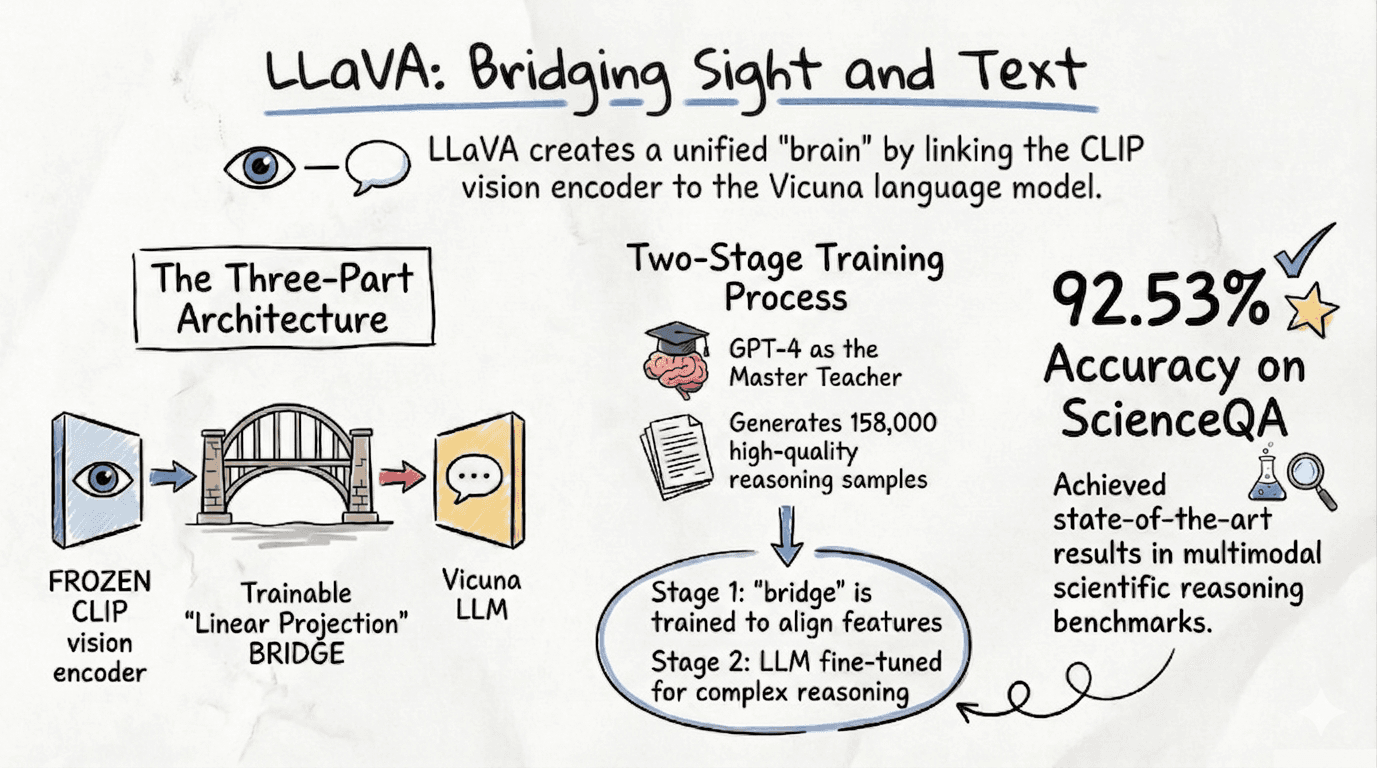
LLaVA is an end-to-end trained large multimodal model designed for general-purpose visual and language understanding. Its architecture is built upon two well-established components:
1. Frozen Vision Encoder (CLIP ViT-L/14)
What is CLIP?
CLIP, or Contrastive Language-Image Pre-training, is a neural network model developed by OpenAI in 2021. It's designed to understand images directly from raw text. CLIP has a dual-encoder architecture: a vision encoder (like a Vision Transformer, ViT) and a text encoder. Both encoders are trained together on a massive dataset of 400 million image-text pairs to project images and text into a shared embedding space. This allows CLIP to determine how well an image and a text description correspond, enabling zero-shot image classification and image captioning without task-specific training.
In LLaVA, the pre-trained CLIP ViT-L/14 vision encoder is kept frozen, meaning its weights are not updated during LLaVA's training. Its role is to extract rich visual features from input images.
2. Large Language Model (Vicuna)
What is Vicuna?
Vicuna is an open-source chatbot model that has gained significant attention for its impressive performance. It is created by fine-tuning a LLaMA base model on approximately 70,000 user-shared ChatGPT conversations. Vicuna uses an auto-regressive, decoder-only transformer architecture, and aims to achieve a high percentage in conversational tasks.
Vicuna serves as the language decoder in LLaVA, responsible for understanding textual instructions and generating coherent responses.
3. Trainable Linear Projection Layer
This is the crucial multimodal connector between the frozen vision encoder and the language model. It maps the visual features extracted by CLIP into the word embedding space of Vicuna. This layer is trainable, allowing for effective alignment of visual and linguistic representations.
The elegant simplicity of connecting these powerful, pre-trained components through a lightweight projection layer is a key aspect of LLaVA's design.
LLaVA Architectural Overview
The Genesis of Knowledge: GPT-4 Powered Data Generation
A cornerstone of LLaVA's success is its novel approach to data generation. Instead of relying solely on human-annotated datasets, LLaVA leverages the advanced capabilities of a language-only GPT-4 model as a "strong teacher" to create a diverse and high-quality multimodal instruction-following dataset.
This process transforms existing image-text pairs into rich instruction-response data, critical for teaching the model complex visual reasoning.
1. Source Data
The process begins with existing image-text pairs, such as those found in datasets like COCO images with alt tags or filtered subsets of Conceptual Captions 3 Million (CC3M).
What is CC3M? The Conceptual Captions 3M (CC3M) dataset consists of approximately 3.3 million images annotated with captions. These captions are harvested from the Alt-text HTML attributes associated with web images and are then filtered and transformed to ensure quality, informativeness, and fluency.
2. Symbolic Representation
To enable GPT-4 to understand the visual context, image information is encoded using symbolic representations:
- Captions: Textual descriptions that summarize the visual scene.
- Bounding Boxes: Coordinates that localize objects within the image, providing spatial relationships.
It's crucial to note that LLaVA does not directly process raw image pixels during this data generation phase; it operates on these derived textual and coordinate data.
3. GPT-4 Querying and Response Generation
GPT-4 is then prompted with these symbolic representations (captions and bounding boxes) and asked to generate various types of instruction-following responses, effectively converting simple image-text pairs into complex conversational or reasoning tasks.
- Conversation: Multi-turn dialogues, answering questions about object types, counts, actions, and locations.
- Detailed Description: Comprehensive and elaborate explanations of the image content.
- Complex Reasoning: In-depth, step-by-step reasoning based on the visual information, such as inferring causality or predicting outcomes.
This innovative data generation strategy yielded 158,000 unique language-image instruction-following samples, comprising 58K conversations, 23K detailed descriptions, and 77K complex reasoning samples. This high-quality, reasoning-heavy dataset is fundamental to LLaVA's advanced multimodal capabilities.
Visual Instruction Tuning: A Two-Stage Training Methodology
LLaVA employs a specialized "Visual Instruction Tuning" (VIT) methodology, structured in two distinct stages to optimize both feature alignment and instruction-following behavior.
Stage 1: Pre-training for Feature Alignment
The initial stage focuses on aligning the visual features from the CLIP encoder with the linguistic embedding space of the Vicuna LLM.
- Goal: To train the projection layer to effectively bridge the gap between visual and linguistic modalities. This stage is crucial for teaching the LLM to "understand" what the visual features represent in its own language space.
- Data: This stage utilizes a large-scale dataset of "naively expanded" image-caption pairs, specifically a filtered subset of the CC3M dataset (e.g., 595K image-text pairs). Simple, single-turn conversations are generated from these pairs (e.g., "Describe this image" -> "caption").
- Trainable Components: During this stage, the weights of both the visual encoder (CLIP) and the LLM (Vicuna) are kept frozen. Only the linear projection layer that connects them is trained. This ensures that the powerful pre-trained knowledge within CLIP and Vicuna is preserved while the connector learns to translate between their representations.
Stage 2: End-to-End Instruction Tuning
Once feature alignment is established, the second stage fine-tunes the model for advanced instruction-following and multimodal reasoning.
- Goal: To enhance LLaVA's ability to engage in multi-turn dialogue, perform complex visual reasoning, and generate diverse instruction-following responses.
- Data: This stage leverages the high-quality, GPT-4 generated multimodal instruction-following data (158K samples). This dataset, rich in conversations, detailed descriptions, and complex reasoning tasks, is pivotal for unlocking LLaVA's advanced capabilities.
-
Training Strategy:
- The model is trained on multi-turn, image-grounded conversations.
- For the first turn, both the image (through its features) and the question (text) are provided to the model. Their order is randomized to improve robustness to prompt variations.
- For subsequent turns, only the textual question is provided. This trains the model to maintain conversational context without needing redundant image inputs, mimicking human interaction where visual context is often established once.
- Training is conducted using an auto-regressive (teacher-forcing) objective, where the model predicts tokens one at a time based on the preceding context.
- Trainable Components: In this stage, the visual encoder weights remain frozen, but both the projection layer and the LLM (Vicuna) weights are updated. This allows the language model to adapt and learn from the rich instruction-following data, enabling deep integration of visual and linguistic understanding.
LLaVA Training Stages
Performance and Capabilities: A Benchmark of Excellence
LLaVA demonstrates remarkable capabilities across various multimodal tasks, showcasing its advanced understanding and reasoning.
Multimodal Chatbot Interactions
LLaVA exhibits strong image understanding and conversational abilities, often providing more comprehensive and accurate responses compared to other models like BLIP-2 or OpenFlamingo. It can engage in multi-turn dialogues, identify specific objects, infer actions, and even detect atypical aspects of an image. This conversational fluency is a direct result of the high-quality, GPT-4 generated instruction-following data it was trained on.
Scientific Reasoning with ScienceQA
One of LLaVA's most impressive achievements is its performance on the challenging ScienceQA dataset.
What is ScienceQA?
ScienceQA is a large-scale multimodal benchmark designed to evaluate machine reasoning and interpretability. It contains approximately 21,208 multiple-choice science questions, drawing from U.S. grade-school curricula (grades 1-12), integrating diverse modalities including text, images (diagrams and natural photos), and combined formats. Crucially, many questions require chain-of-thought explanations, making it a robust test of multi-hop inference and scientific reasoning.
When fine-tuned on ScienceQA, LLaVA achieves an impressive 92.53% state-of-the-art accuracy. This remarkable score highlights LLaVA's ability to not only process multimodal information but also apply complex scientific reasoning to arrive at correct answers.
GPT-4 as an Evaluator ("Judge")
Beyond data generation, GPT-4 also plays a pivotal role in evaluating LLaVA's performance.
What is GPT-4 as a Judge?
This methodology involves using a powerful LLM (like GPT-4) to autonomously evaluate the outputs of other models. GPT-4 can perform pairwise comparisons between model responses, assign pointwise scores (e.g., 1-10) based on criteria like helpfulness, relevance, accuracy, and detail, and even provide open-ended explanations for its judgments. This approach offers a scalable alternative to human evaluation, although researchers are aware of potential biases, such as favoring verbose responses or being overly optimistic.
In the context of ScienceQA, GPT-4 acts as a judge to combine its own text-only reasoning with LLaVA's multimodal output, leading to the reported state-of-the-art accuracy. LLaVA achieves a relative score of 85.1% compared to GPT-4 on a synthetic multimodal instruction-following dataset, indicating strong alignment with GPT-4's capabilities.
Interactive Code Generation
LLaVA also demonstrates emerging capabilities beyond traditional question answering. For instance, it can generate HTML/JavaScript code for interactive web pages based on user sketches and instructions. This showcases its potential to translate complex visual and textual inputs into functional, executable code, opening doors for innovative applications in web development and design automation.
Observed Limitations: The "Bag of Patches" Perception
Despite its impressive performance, LLaVA, like many contemporary MLLMs, exhibits certain limitations. A notable challenge is its tendency towards a "bag of patches" perception. This refers to situations where the model may struggle to fully grasp the complex semantics and intricate relationships between objects within an image.
This can lead to subtle hallucinations, where the model generates information that is factually incorrect, inconsistent, or not supported by the visual content. For example, it might misidentify specific items or attributes in a crowded scene, or infer incorrect relationships between objects. These hallucinations can arise from data quality issues, architectural challenges, or modality-specific misalignments. Addressing these nuanced understanding gaps and reducing hallucinations remains an active area of research for future multimodal models.
Conclusion
LLaVA represents a significant milestone in the development of multimodal large language models. By elegantly connecting a frozen vision encoder (CLIP) with a large language model (Vicuna) and pioneering a GPT-4 driven data generation strategy, LLaVA has demonstrated impressive capabilities in multimodal chat, complex visual reasoning, and achieving state-of-the-art results on benchmarks like ScienceQA. Its open-source availability further democratizes access to advanced MLLM research and development. While challenges like the "bag of patches" perception and visual hallucinations highlight areas for future improvement, LLaVA's innovative architecture and training methodology provide a robust foundation for the next generation of intelligent, visually-aware AI systems.
Further Reading
- Multimodal Large Language Models (MLLMs) Architectures
- Instruction Tuning for Large Language Models
- Zero-shot and Few-shot Learning in Vision-Language Models
- Advanced Data Synthesis Techniques for AI Training
- Benchmarks for Multimodal AI Evaluation
- Mitigating Hallucinations in Generative AI Models