How did diffusion LLMs get so fast?
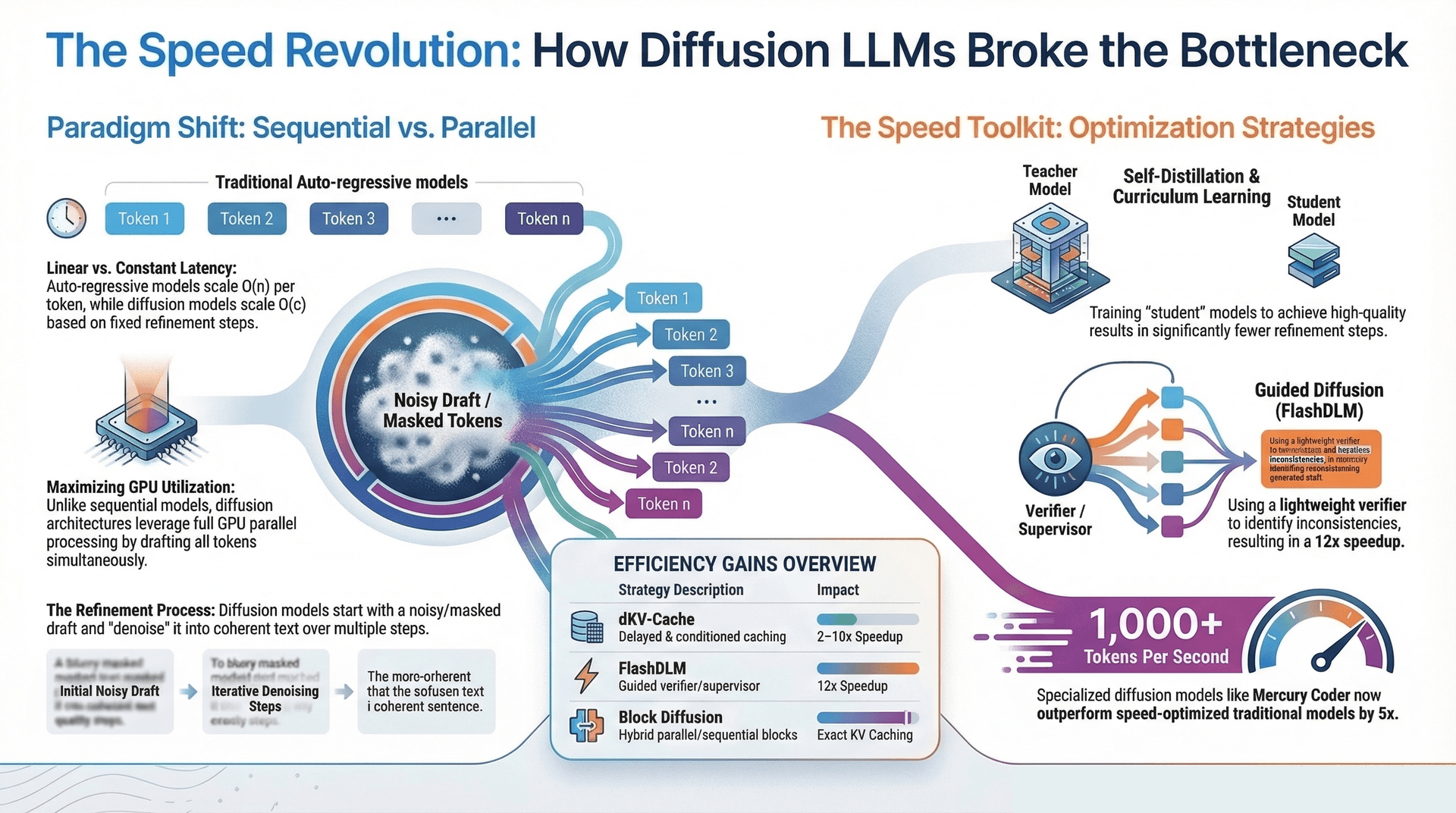
Accelerating Large Language Models: The Rise of Diffusion-Based Architectures
The field of large language models (LLMs) is rapidly advancing, with a continuous drive towards more efficient and faster text generation. Traditionally, LLMs have relied on an auto-regressive paradigm, generating text one token at a time. While powerful, this sequential nature presents inherent speed bottlenecks. A new wave of diffusion-based LLMs is emerging, promising a fundamental shift towards parallel generation and significant speed improvements.
This blog post delves into the architectural innovations and training techniques that are making diffusion LLMs remarkably fast, examining their core differences from traditional models and exploring the cutting-edge methods that enhance their performance.
Understanding the Bottleneck: Auto-Regressive vs. Diffusion LLMs
To appreciate the advancements in diffusion LLMs, it's crucial to understand the limitations of their predecessors.
Auto-Regressive LLMs: The Sequential Paradigm
Auto-regressive LLMs generate text by predicting the next token based on all previously generated tokens. This process is inherently sequential, meaning each token generation step must wait for the previous one to complete.
- Linear Inference Latency: This sequential nature leads to a linear inference latency, scaling as O(n), where 'n' is the number of output tokens. Even with powerful GPUs, the "next-token prediction" dependency creates a speed bottleneck.
- GPU Underutilization: While GPUs are excellent at parallel processing, auto-regressive models cannot fully leverage this capacity for sequential token generation.
Diffusion LLMs: Embracing Parallelism
Diffusion LLMs operate on a fundamentally different principle. Instead of generating tokens one by one, they generate an entire response draft simultaneously, then progressively refine it over a fixed number of steps.
- Constant Inference Latency: This iterative refinement, performed in parallel across all tokens, results in a more constant inference latency, scaling as O(c), where 'c' is the fixed number of refinement steps. This allows diffusion models to leverage full GPU capacity more effectively.
- Overcoming the Bottleneck: By moving away from strict sequential generation, diffusion LLMs overcome the speed limitations inherent in auto-regressive models, enabling faster response times for text generation tasks.
The initial promise of diffusion LLMs, however, was tempered by their need for a large number of diffusion steps (e.g., 1024 steps in early models like LLaDA 8B), making them only marginally faster than their auto-regressive counterparts. The quest for true speed in diffusion LLMs hinges on two key objectives:
- Reducing the number of diffusion steps (low 'c').
- Ensuring each individual diffusion step is fast.
graph TD
    subgraph Auto-Regressive LLM
        A[Start] --> B(Predict Token 1)
        B --> C(Predict Token 2 based on Token 1)
        C --> D(Predict Token 3 based on Token 1, 2)
        D --> E(...)
        E --> F(End)
        style A fill:#f9f,stroke:#333,stroke-width:2px
        style F fill:#f9f,stroke:#333,stroke-width:2px
    end

    subgraph Diffusion LLM
        G[Start] --> H(Generate Noisy Draft)
        H --> I(Refine Draft - Step 1: Parallel Denoising)
        I --> J(Refine Draft - Step 2: Parallel Denoising)
        J --> K(...)
        K --> L(Refine Draft - Step c: Parallel Denoising)
        L --> M(End)
        style G fill:#ccf,stroke:#333,stroke-width:2px
        style M fill:#ccf,stroke:#333,stroke-width:2px
    end

    classDef AR_latency fill:#ffc,stroke:#333,stroke-width:1px;
    classDef Diffusion_latency fill:#ccf,stroke:#333,stroke-width:1px;
    class B,C,D,E AR_latency
    class I,J,K,L Diffusion_latency

    subgraph Latency Comparison
        N(Auto-Regressive Latency: O n)
        O(Diffusion Latency: O c)
    end
Strategies for Accelerated Diffusion LLMs
Current research focuses on two primary areas to significantly enhance the speed of diffusion LLMs: training techniques to reduce the number of necessary refinement steps, and inference algorithms to accelerate each individual step.
Training Techniques: Reducing Refinement Steps
Knowledge Distillation, especially Self-Distillation
Knowledge Distillation is a technique where a smaller, "student" model is trained to mimic the behavior of a larger, more complex "teacher" model. In the context of diffusion LLMs, this means:
- A teacher model, initially trained for high accuracy over many diffusion steps, guides the training of a student model.
- The student model is fine-tuned to produce comparable quality with a significantly reduced number of diffusion steps.
- This process can be iteratively applied (e.g., reducing steps from N to N/2, then to N/4) to progressively decrease inference steps while maintaining output quality.
- Self-distillation, a specific form of knowledge distillation, involves using a diffusion model to distill knowledge into a simpler, faster version of itself after initial training, making it a powerful post-training technique.
Curriculum Learning
Curriculum Learning is a pre-training strategy inspired by human learning, where a model is gradually exposed to increasingly difficult tasks.
- Instead of uniform training across all noise levels, the model first learns to denoise easier tasks or cleaner data (less noisy).
- It then progresses to noisier data and more complex denoising scenarios.
- This structured approach enhances the model's robustness and efficiency, enabling it to achieve more significant denoising in fewer steps, thus reducing the overall refinement steps required during inference.
Optimizing Individual Diffusion Steps: Inference Algorithms (Samplers)
While training techniques reduce the number of steps, inference algorithms, or samplers, focus on making each step as fast and effective as possible. Diffusion LLMs offer greater flexibility in their noise processes (e.g., masking tokens, changing token values) compared to auto-regressive models.
Samplers are crucial in determining which tokens to "commit" (fix) and which to "uncover" (denoise) at each step. Masked Diffusion LLMs (the current dominant paradigm) begin by concatenating a prompt with a fully masked response. The model predicts a full response, then strategically re-masks a subset of the newly uncovered tokens for further refinement. A "smart sampler" can significantly reduce refinement steps by strategically operating on the most uncertain or impactful tokens, balancing computational cost with output quality.
The Problem with Naive Diffusion Masking
Simple masking algorithms often mask tokens randomly. While this matches the training objective, it is not optimal during inference. For instance, in a sentence like "The capital of France is [MASK]," a naive approach might mask "France," even if it's clearly correct based on context.
Even with confidence scores to guide re-masking, diffusion models can sometimes produce redundant tokens (e.g., "Madrid" twice in a list of capitals). This redundancy arises from the parallel prediction mechanism, where tokens are generated without full awareness of other tokens' states, leading to a structural weakness in basic masked diffusion LLMs.
Solution: Guided Diffusion (FlashDLM)
To address the issues of token incoherence and redundancy, Guided Diffusion (as implemented in systems like FlashDLM) introduces a clever mechanism. It employs a lightweight auto-regressive supervisor LLM to guide the unmasking process. This supervisor does not generate the full text but acts as a verifier. The supervisor makes next-word predictions based on the left context of an intermediate draft from the diffusion model. It then compares the tokens proposed by the diffusion model against its own auto-regressive predictions.
If there's an inconsistency (e.g., the supervisor assigns a near-zero probability to a token the diffusion model predicted), that token is re-masked for further refinement by the diffusion model. This approach enables the model to identify and correct inconsistencies at a global level efficiently. FlashDLM, for example, has demonstrated significant speedups (e.g., 12× faster than a baseline) while improving output quality.
graph TD
    A[Diffusion Model - Drafter
Generates Full Response Draft] --> B{Auto-Regressive Supervisor
Verifier Reviews Draft};
    B -- Checks Left Context --> C[Supervisor Predicts
Next Token Probabilities];
    B -- Compares with Drafted Tokens --> D{Consistency Check?};
    D -- Yes --> E[Keep Token - Unmasked];
    D -- No --> F[Re-mask Token for
Further Refinement];
    F --> A;
Enhancing Inference Speed: KV Caching Challenges and Solutions
A major contributor to LLM inference speed is Key-Value (KV) caching, but its application differs significantly between auto-regressive and diffusion models.
KV Caching in Auto-Regressive LLMs
In auto-regressive LLMs, KV caching is highly effective due to their causal attention mechanism.
- A token's embedding only depends on its left context.
- This means that the key and value embeddings for previously generated tokens remain stable and can be reused across subsequent generation steps, significantly reducing redundant computation.
The Diffusion Dilemma: Bidirectional Attention and Invalidation
KV caching, as traditionally implemented, is not directly applicable to diffusion LLMs.
- Bidirectional Attention: Diffusion models use bidirectional attention, where every token's embedding depends on all other tokens in the sequence (both left and right context).
- Embedding Invalidation: When even a single token is unmasked or changed during a denoising step, its influence propagates across the entire sequence. This invalidates all internal token embeddings, making direct reuse of cached KV states impossible. This phenomenon is often described as a "virus spreading" through the embeddings.
Approximate KV Caching (dLLM-Cache, dKV-Cache, FreeCache, Elastic-Cache)
Researchers have developed approximate KV caching strategies to overcome this limitation. These approaches leverage empirical observations about how token embeddings change.
- Empirical Observation: While response token embeddings change significantly upon unmasking, and all embeddings technically update, the embeddings for the prompt portion and already stable, unmasked response tokens tend to change very little across denoising steps.
- Delayed and Conditioned Caching: Methods like dKV-Cache propose a delayed and conditioned caching strategy, reusing KV states for tokens that have stabilized (e.g., decoded in previous steps) while recomputing for tokens still being masked. This enables significant inference speedups (2–10×) with minimal performance degradation.
- Periodic Refresh: Since subtle changes do accumulate over time, these caches need to be refreshed at regular intervals (e.g., every 100 steps) to mitigate staleness and maintain accuracy.
- Fast-dLLM also employs a block-wise approximate KV Cache combined with confidence-aware parallel decoding.
- FreeCache is another training-free KV approximation technique that reuses stable KV projections.
- Elastic-Cache adaptively recomputes KV caches for diffusion LLMs by exploiting observations that KV drift is small for most steps and grows with layer depth. It performs adaptive, layer-aware cache updates.
| Method | Key Idea | Speedup |
|---|---|---|
| dKV-Cache | Delayed & conditioned caching for stabilized tokens | 2–10× |
| Fast-dLLM | Block-wise approximate cache + confidence-aware decoding | Significant |
| FreeCache | Training-free reuse of stable KV projections | Moderate |
| Elastic-Cache | Adaptive, layer-aware cache updates based on KV drift | Adaptive |
graph TD
    subgraph Auto-Regressive Attention
        A[Token 1] --> B[Token 2]
        A --> C[Token 3]
        B --> C
    end

    subgraph Diffusion Attention
        D[Token 1] <--> E[Token 2]
        D <--> F[Token 3]
        E <--> F
    end

    subgraph KV Cache Impact
        G[Auto-Regressive: Causal Attention
enables direct KV Cache reuse]
        H[Diffusion: Bidirectional Attention
causes KV invalidation]
    end
Hybrid Approaches: Block Diffusion (Semi Auto-Regression)
To gain the benefits of both worlds - the precise KV caching of auto-regressive models and the parallel generation power of diffusion - a hybrid approach called Block Diffusion, also known as Semi Auto-Regression, has emerged.
- Motivation: While approximate KV caching for pure diffusion models is a step forward, achieving exact KV caching and handling variable output lengths efficiently remains a challenge.
-
Mechanism: Block Diffusion splits a long context
window into equally sized blocks.
- Within a block: Tokens are generated in parallel using a diffusion process.
- Between blocks: Blocks are generated sequentially from left to right, similar to an auto-regressive model.
-
Attention Pattern:
- A token in the current block attends causally to all tokens in previous blocks.
- A token in the current block attends bidirectionally to other tokens within its own block.
-
Benefits:
- Exact KV Caching: Once a block is finalized, its activations from the last denoising step can be cached and precisely reused by subsequent blocks - a significant advantage over approximate methods. This is also referred to as hierarchical caching in some implementations like Fast-dLLM.
- Variable Length Generation: Sampling can stop early when an end-of-sequence token is produced, eliminating the need to fill an entire context window, which is a limitation of some pure diffusion models.
- Compromise: Block Diffusion represents a balanced approach, interpolating between full parallelism (pure diffusion) and full sequential generation (auto-regressive LLMs). Models like Seed Diffusion and the LLaDA family of models adopt this hybrid architecture.
graph TD
    subgraph Block Diffusion
        B1[Block 1: Diffusion Generation] --> B2[Block 2: Diffusion Generation]
        B2 --> B3[Block 3: Diffusion Generation]
        B1 -- Causal Attention to Previous --> B2
        B2 -- Causal Attention to Previous --> B3

        subgraph Within Block 1
            T1_1[Token 1.1] <--> T1_2[Token 1.2]
            T1_1 <--> T1_3[Token 1.3]
            T1_2 <--> T1_3
        end

        subgraph Within Block 2
            T2_1[Token 2.1] <--> T2_2[Token 2.2]
            T2_1 <--> T2_3[Token 2.3]
            T2_2 <--> T2_3
        end

        subgraph Within Block 3
            T3_1[Token 3.1] <--> T3_2[Token 3.2]
            T3_1 <--> T3_3[Token 3.3]
            T3_2 <--> T3_3
        end

        B1 --> |Finalized Activations| KV1(KV Cache for Block 1)
        B2 --> |Finalized Activations| KV2(KV Cache for Block 2)
        KV1 -- Reused by --> B2

    end

    style B1 fill:#e6e6fa,stroke:#333,stroke-width:2px;
    style B2 fill:#e6e6fa,stroke:#333,stroke-width:2px;
    style B3 fill:#e6e6fa,stroke:#333,stroke-width:2px;
The Landscape of Diffusion Language Models
Diffusion models are rapidly gaining traction and are predicted to become a leading paradigm for generating discrete objects like text and code, potentially rivaling or even surpassing auto-regressive models due to their fundamental efficiency in inference time.
Open-Source Models
The open-source community is a vibrant hub for diffusion LLM development.
- Hugging Face: This platform is a primary resource for finding open-source Diffusion Language Models.
-
Search Tags: Users can often find relevant models by
searching for tags like "dLLM" or
"LLaDA" (e.g., on
huggingface.co/models?other=dllmorhuggingface.co/models?other=llada), with over a hundred options available. The dLLM framework also provides a unified approach for training, inference, and evaluation of diffusion language models.
Commercial APIs and Specialized Applications
Several commercial entities are also at the forefront of deploying diffusion LLMs, offering powerful APIs and specialized functionalities.
-
Inception Platform: Offers a commercial API for
their Mercury Diffusion Models.
- OpenAI-Compatible: These models often provide chat completions that are compatible with the OpenAI API, easing integration for developers.
-
Specialized Endpoints: Diffusion models excel
in tasks requiring parallel generation and iterative refinement,
leading to specialized endpoints optimized for:
- Streaming & Diffusion: For real-time feedback and visualizing the denoising process.
- Realtime: For instant responses.
- FIM (Fill-in-the-Middle): Particularly well-suited for code autocompletion and editing, where a model needs to generate content between a prefix and a suffix.
- Other specialized capabilities include Next Edit, Apply Edit, and Structured Outputs.
- Performance: Diffusion LLMs, such as Mercury Coder, have demonstrated strong performance in tasks like FIM, often outperforming auto-regressive models in speed (e.g., over 1,000 tokens per second on NVIDIA H100s - a 5× increase compared to speed-optimized auto-regressive models). They can also achieve high throughput that was previously only seen with specialized hardware.
graph LR
    A[Diffusion LLMs] --> B{Open-Source Platforms};
    A --> C{Commercial APIs};

    B -- Hugging Face --> D[Model Hub];
    D -- Search Tags --> E[dLLM / LLaDA];

    C -- Inception Platform --> F[Mercury Diffusion Models];
    F -- Offers --> G[OpenAI-Compatible
Chat Completions];
    F -- Offers --> H[Specialized Endpoints];

    H --> H1[Streaming and Diffusion];
    H --> H2[Realtime];
    H --> H3[FIM - Fill-in-the-Middle];
    H --> H4[Next Edit / Apply Edit /
Structured Outputs];
Conclusion
The evolution of Large Language Models is at a pivotal juncture, with diffusion-based architectures offering a compelling alternative to the traditional auto-regressive paradigm. By leveraging parallel generation and iterative refinement, diffusion LLMs address the inherent speed bottlenecks of sequential processing. Key advancements in training techniques like Knowledge Distillation and Curriculum Learning are significantly reducing the necessary refinement steps, while innovative inference algorithms such as Guided Diffusion (FlashDLM) enhance the efficiency and coherence of each step.
Furthermore, breakthroughs in Approximate KV Caching and the emergence of Block Diffusion (Semi Auto-Regression) are tackling the complex challenge of managing context and achieving precise caching in bidirectional models. These developments collectively pave the way for a new generation of LLMs that are not only faster and more efficient but also excel in specialized applications like code completion (FIM) and real-time interactive experiences. As the field continues to mature, diffusion LLMs are poised to redefine the standards for speed, cost-efficiency, and functionality in generative AI.
Key Takeaways
- Diffusion LLMs generate text in parallel, achieving O(c) latency versus O(n) for auto-regressive models.
- Knowledge Distillation and Curriculum Learning reduce the number of required refinement steps.
- Guided Diffusion (FlashDLM) uses an auto-regressive verifier to improve coherence and achieve up to 12× speedups.
- Approximate KV Caching methods (dKV-Cache, FreeCache, Elastic-Cache) enable 2–10× inference speedups.
- Block Diffusion combines the best of both worlds - parallel generation within blocks and exact KV caching between blocks.