Hierarchical Reasoning Models

Unleashing Deeper Reasoning: Exploring Hierarchical Reasoning Models
The quest for artificial intelligence that can tackle complex problems with human-like reasoning has led to a fascinating array of neural network architectures. While Large Language Models (LLMs) have demonstrated impressive capabilities, they often grapple with challenges like brittle task decomposition, extensive data requirements, and high latency for intricate reasoning tasks. Addressing these limitations, a novel architecture, the Hierarchical Reasoning Model (HRM), emerges, drawing inspiration from the very structure of the human brain's problem-solving mechanisms.
HRM is designed for hierarchical processing and temporal separation, enabling it to perform robust and efficient reasoning. At its core, it employs two interdependent modules: a High-level (H-module) for abstract planning and a Low-level (L-module) for rapid, detailed computations. This unique design allows HRM to achieve exceptional performance on challenging reasoning benchmarks such as ARC-AGI, Sudoku-Extreme, and Maze-Hard, often with significantly fewer parameters and training data compared to its counterparts.
This blog post will delve into the architecture and operational principles of Hierarchical Reasoning Models, exploring how they achieve their remarkable performance through innovative training strategies, including approximate gradients and adaptive computational time.
The Brain-Inspired Architecture: Hierarchical Reasoning Model (HRM)
The Hierarchical Reasoning Model is a recurrent neural network (RNN) architecture that mimics the brain's ability to process information at multiple timescales. A recurrent neural network is a type of artificial neural network where connections between nodes form a directed graph along a temporal sequence, allowing it to exhibit temporal dynamic behavior. This means unlike feedforward neural networks, RNNs can use their internal state (memory) to process sequences of inputs.
The HRM's architecture fundamentally relies on two interacting RNNs, or modules, each operating at a distinct pace:
-
High-level Module (H-module): This module functions at
a slower pace, updating its state only once per "cycle" (every
Ttimesteps of the L-module). Its primary responsibilities include:- Abstract Planning: Formulating overarching strategies and maintaining a high-level understanding of the problem.
- Context Provision: Supplying a "fresh context" or updated strategic guidance to the L-module for the next computational cycle.
-
Low-level Module (L-module): In contrast, the L-module
operates at a rapid pace, updating its state at every timestep within a
cycle. Its roles involve:
- Detailed Computation: Performing intensive search and refinement operations.
- Iterative Processing: Taking the input data, its own previous state, and the H-module's current state to execute granular steps.
Hierarchical Update Mechanism
The synergy between these modules is crucial. The L-module continuously
updates its hidden state, diligently working on the finer details of the
problem. After T steps, the H-module observes the aggregated
output or final state of the L-module. Based on this observation, the
H-module updates its own hidden state, effectively refining its high-level
strategy. This newly updated high-level context is then fed back to the
L-module, which essentially "restarts" its detailed
computational path with a fresh, strategically informed perspective.
This mechanism enables an iterative refinement process, promoting
gradual convergence over many steps. Unlike standard
RNNs, which can sometimes converge prematurely, HRM's hierarchical
structure prevents stagnation and maintains high computational activity,
leading to more robust problem-solving. It also enables an effective
computational depth of NT steps (where N is the
number of cycles), significantly enhancing its capacity for complex
computations while mitigating issues like vanishing or exploding gradients
often encountered in very deep networks.
Both the L-module and H-module in the HRM are typically implemented using encoder-only transformer blocks. A transformer block is a fundamental building block of transformer models, utilizing self-attention mechanisms to weigh the importance of different parts of the input sequence. In HRM, the inputs to these blocks are combined via simple addition to integrate the different information streams.
graph TD
    A[Input Data] --> B{L-Module Updates}
    B -- Every Timestep --> C[L-Module State]
    C -- After T Timesteps --> D{H-Module Updates}
    D -- Once per Cycle --> E[H-Module State]
    E -- Provides Context --> B
    C -- Aggregated Output --> D
    E -- Guides L-Module --> B
    B -- Refined Output --> F[Output/Prediction]
Figure 1: Diagram illustrating the interaction between the High-level (H)
and Low-level (L) modules in HRM.
Efficient Training: Approximate Gradients and Deep Supervision
Training complex recurrent models like HRM efficiently presents unique challenges, particularly regarding gradient computation.
The Challenge of Backpropagation Through Time (BPTT)
Backpropagation Through Time (BPTT) is the standard algorithm used to train recurrent neural networks. It involves "unrolling" the network through time, essentially treating it as a very deep feedforward network, and then applying backpropagation. While effective, BPTT is notoriously slow and memory-intensive, as it requires storing all intermediate hidden states for the entire sequence to compute gradients accurately.
Approximate Gradients for Scalability
HRM addresses the memory burden of full BPTT by employing an approximate gradient method. This method is rooted in the idea that if a recurrent neural network's hidden state converges to a fixed point (a stable state where further iterations do not significantly change the state), then its state sequence can be effectively "unrolled" in a single step for gradient calculation. This concept draws theoretical support from the Implicit Function Theorem, which is utilized in methods for training implicit models.
The "one-step gradient" approximation simplifies the full
gradient by considering only the first term of a series expansion (e.g., a
Neumann series expansion). This results in a significant advantage:
O(1) memory usage for gradient computation,
as it avoids the need to store the entire history of hidden states.
Here's how it works:
- Forward Pass: The HRM's L-module and H-module iterate multiple times until their hidden states converge to a stable, fixed point. During this iterative process, no gradients are tracked.
- Backward Pass: Once the model reaches this converged state, the hidden state at this fixed point is "detached" from the computation graph. Gradients are then calculated only from this final, detached state, effectively simplifying backpropagation to a single step.
While this approximation means the resulting gradients might be noisier compared to full BPTT, it dramatically improves computational efficiency and memory footprint, making it feasible to train deeper, more complex recurrent structures. This mechanism also bears a plausible resemblance to local learning rules observed in biological brains.
Deep Supervision with Gradient Detaching
HRM further enhances training efficiency and stability through a technique called Deep Supervision, particularly when combined with the approximate gradient method.
Instead of computing a single loss at the very end of a long sequence, HRM processes data in multiple sequential "segments." For each segment:
- The HRM takes the previous hidden state (or an initial state) and the input for that segment.
- It computes a new hidden state and an output.
- Crucially, a loss is computed and model parameters are updated after each segment's forward pass.
- Before the hidden state of a segment is passed as input to the next segment, it is "detached" from the computation graph. This deliberate detaching is key: it prevents gradients from propagating backward through multiple segments, effectively enforcing the 1-step gradient approximation and avoiding the computational and memory overhead of full BPTT.
The benefits of this deep supervision with gradient detaching are multifold:
- Avoids BPTT Burden: Directly prevents the memory and computational explosion associated with full BPTT in deep recurrent networks.
- Frequent Learning Signals: Provides more frequent and dense learning signals, combating the problem of sparse loss feedback in very long sequences.
- Iterative Refinement: Allows the model to iteratively refine its internal state and prediction through multiple updates within a single overarching input, contributing to stable, slow convergence.
Adaptive Computational Time (ACT): Thinking Fast and Slow
One of HRM's most compelling features is its ability to dynamically control its computational effort using Adaptive Computational Time (ACT), a strategy inspired by the concept of "thinking fast and slow."
The Motivation for Adaptive Halting
Not all problems require the same amount of "thought." Simpler tasks might be solvable with fewer computational steps, while complex ones demand more extensive processing. Traditional neural networks often perform a fixed number of operations, leading to wasteful computation for easy tasks or insufficient processing for harder ones. ACT addresses this by allowing the HRM to adaptively determine the optimal number of computational steps (segments or iterations) for each input sample.
How ACT Works: The Q-Head Mechanism
ACT integrates a Q-learning algorithm directly into the HRM. A dedicated
"Q-head" module is attached to the final hidden
state of the HRM at each segment (m). This Q-head predicts
two critical values:
-
Q_halt^m: The estimated reward for stopping computation at the current segment. -
Q_continue^m: The estimated reward for continuing computation to the next segment.
The model decides to "halt" if
Q_halt^m is greater than Q_continue^m;
otherwise, it "continues" to the next segment.
To ensure stability, fixed hyperparameters such as
M_max (maximum number of segments) and
M_min (minimum number of segments) are typically included to
prevent infinite loops and guarantee a minimum processing time.
graph TD
    A[HRM Hidden State M] --> B{Q-Head}
    B -- Predicts --> C[Q_halt M]
    B -- Predicts --> D[Q_continue M]
    C & D --> E{Compare Q-values}
    E -- If Q_halt M > Q_continue M --> F[HALT & Output]
    E -- Else --> G[CONTINUE to M+1]
    G --> A
Figure 2: Diagram illustrating the Adaptive Computational Time (ACT)
decision process using a Q-head.
Q-Learning for Halting Decision
The Q-learning mechanism trains the model to make these decisions effectively:
-
Reward for Halting (
G_halt^m): This is a straightforward binary reward (1 if the prediction at segmentmis correct, 0 otherwise). This encourages the model to halt when it believes it has reached an accurate solution. -
Reward for Continuing (
G_continue^m): This is a more nuanced reward designed to look ahead:-
If the maximum number of segments (
M_max) is reached,G_continue^mis set toQ_halt^{m+1}, effectively forcing a halt in the next step. -
Otherwise,
G_continue^mis the maximum ofQ_halt^{m+1}andQ_continue^{m+1}. This teaches the model to anticipate the best future action (whether to halt or continue) if it chooses to proceed to the next segment.
-
If the maximum number of segments (
The overall loss function for ACT combines the standard prediction loss with a binary cross-entropy loss on these Q-values and their targets.
Training Efficiency and Performance Benefits
ACT significantly boosts training efficiency. During batch processing, when a sample in the batch halts, it is immediately replaced with a fresh sample from the dataloader. This continuous processing avoids "holes" in the computation graph, ensuring full GPU utilization.
The performance benefits are substantial:
- Computational Savings: ACT drastically reduces the average number of computational steps required, especially for simpler tasks.
- Maintained/Improved Accuracy: Despite using less computation, HRM with ACT often achieves accuracy comparable to or even better than fixed-iteration models.
-
Inference-Time Scaling: For highly challenging problems
during inference,
M_maxcan be increased, allowing the model to use more computational resources and achieve improved performance without needing retraining or architectural changes.
| Feature | Fixed Iteration Models | HRM with ACT |
|---|---|---|
| Computational Steps | Fixed, regardless of complexity | Dynamic, adapts to task complexity |
| Average Compute | High, even for simple tasks | Significantly reduced |
| Resource Usage | Potentially inefficient | Optimized |
| Accuracy | Can be limited by fixed steps | Maintained or improved |
| Inference Flexibility | Limited by training configuration | Scalable for harder problems |
Performance and Real-World Implications
Despite its modest scale—boasting only around 27 million parameters and achieving results with as few as 1000 training samples—HRM makes compelling performance claims on complex reasoning tasks. It reportedly outperforms much larger state-of-the-art LLMs (e.g., Deepseek R1, Claude 3.7 8K) on inductive benchmarks.
Key performance highlights include:
- Maze-Hard (30x30): HRM achieves an impressive 74.5% accuracy, whereas other models score 0%.
- Sudoku-Extreme (9x9): HRM reaches 55% accuracy, with competitors again scoring 0%.
- ARC-AGI-1/2: The model demonstrates significantly higher accuracy than existing benchmarks.
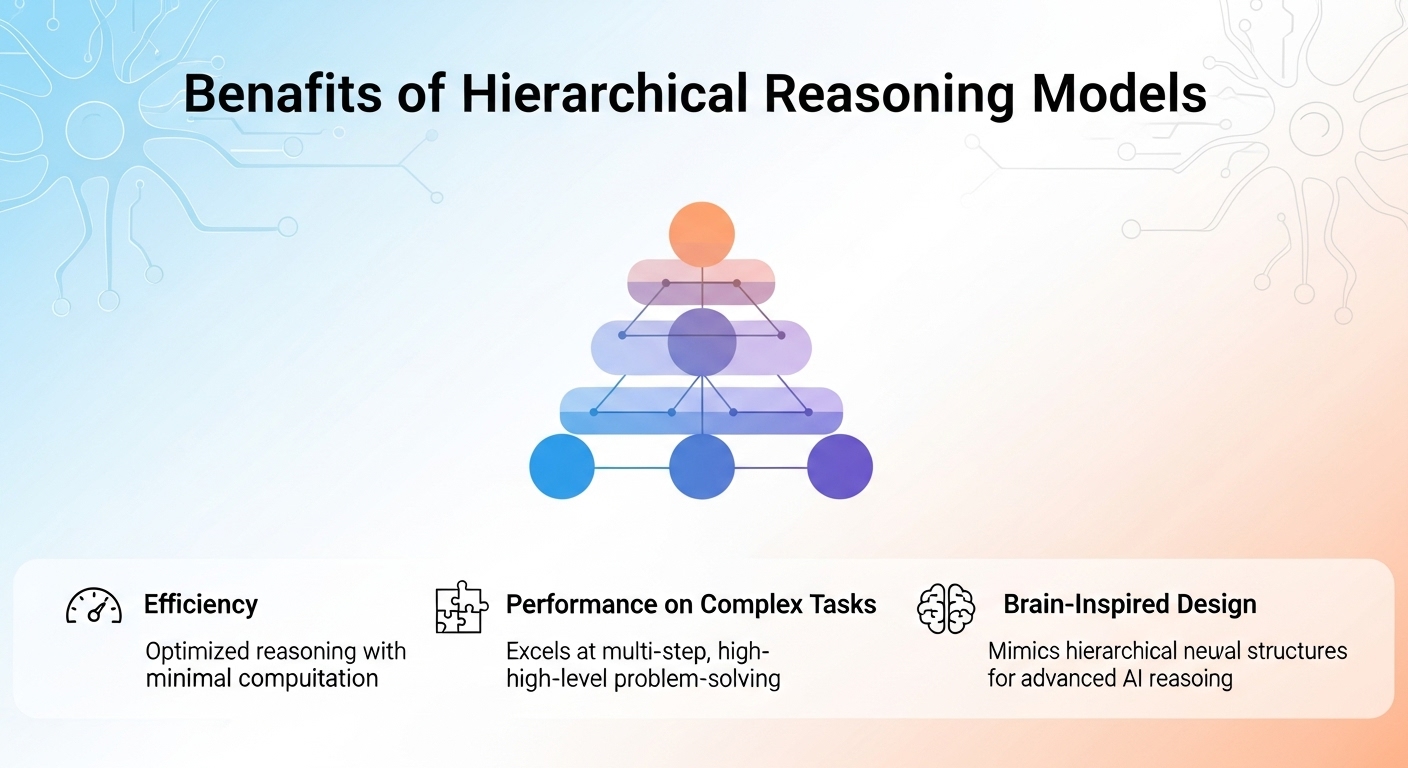
Figure 3: Infographic summarizing the key advantages and features of Hierarchical Reasoning Models.
Real-World Applications
The robust reasoning capabilities of HRMs open doors for numerous applications across various industries:
- Complex Problem Solving: HRMs could accelerate scientific discovery by reasoning through experimental results, assist in drug design by optimizing molecular structures, or enhance financial modeling by identifying complex market patterns and making strategic decisions.
- Planning and Logistics: In robotics, HRMs could enable more sophisticated path planning and task sequencing. For supply chain management, they could optimize complex logistical operations, such as dynamic routing and resource allocation, by performing abstract planning and detailed execution.
- Advanced Game AI: Beyond simply playing games, HRMs could develop more human-like strategic thinking in complex games like Go or chess, by understanding the deeper implications of moves rather than just brute-force calculation. This goes beyond traditional tree-search algorithms by incorporating learned, hierarchical strategies.
- Autonomous Systems: From self-driving cars navigating unpredictable environments to drones performing intricate inspections, HRMs could provide the multi-level reasoning needed for robust decision-making in real-time.
- Explainable AI (XAI): The iterative and hierarchical nature of HRM's processing could potentially offer more interpretable reasoning steps, making it easier to understand why a model arrived at a particular conclusion, a crucial aspect for trust and deployment in critical systems.
Critical Discussion and Future Directions
While the performance claims of HRM are indeed "interesting" and "cool," it is vital to approach them with a nuanced perspective. Ongoing discussions within the AI community, including those highlighted by the video's presenter, raise important considerations:
- Data Augmentation: For benchmarks like ARC-AGI, the dataset involves extensive augmentation, including translations, rotations, flips, and color permutations. Furthermore, the generation and solving of 1000 augmented variants for training raises questions about whether this constitutes "implicitly training on the test set," potentially inflating reported results.
- "Brain Correspondence": While the brain-inspired design is a strong motivator, some skepticism exists regarding the extent to which a transformer-based model truly mimics the intricate biological processes of the brain. The detailed neuroscientific diagrams in research papers, while illustrative, might sometimes overstate the direct biological equivalence.
Nevertheless, HRM's architectural choices for computational stability and
efficiency are noteworthy. The model demonstrates
stable, slow convergence for the overall system. The
H-module's context (z_H) steadily adapts, while the L-module
repeatedly converges within its cycles, with these internal convergences
being "reset" by the H-module. This leads to "residual
spikes" in forward residuals, which stabilize over time,
demonstrating a robust computational process in contrast to the rapid
initial convergence and subsequent stagnation often seen in traditional
RNNs, or the divergence and exploding residuals found in some very deep
neural networks.
Conclusion
Hierarchical Reasoning Models represent a compelling advancement in neural network architecture, offering a powerful approach to sequential reasoning tasks. By elegantly combining brain-inspired hierarchical processing with innovative training techniques like approximate gradients and adaptive computational time, HRMs demonstrate exceptional performance on complex benchmarks with remarkable efficiency.
While the discussion surrounding the interpretation of benchmarks and the extent of their biological inspiration is ongoing, the core principles of HRM—decoupling high-level planning from low-level execution and dynamically managing computational resources—offer significant promise. These models contribute a valuable perspective on how to build more intelligent, efficient, and robust AI systems capable of deeper, more nuanced reasoning in an increasingly complex world.
Further Reading
- Recurrent Neural Networks (RNNs)
- Transformer Architecture
- Backpropagation Through Time (BPTT)
- Implicit Function Theorem in Machine Learning
- Reinforcement Learning (Q-Learning)
- Adaptive Computational Time (ACT) in Neural Networks
- Hierarchical Reinforcement Learning