Contrastive learning for Vision Language Models
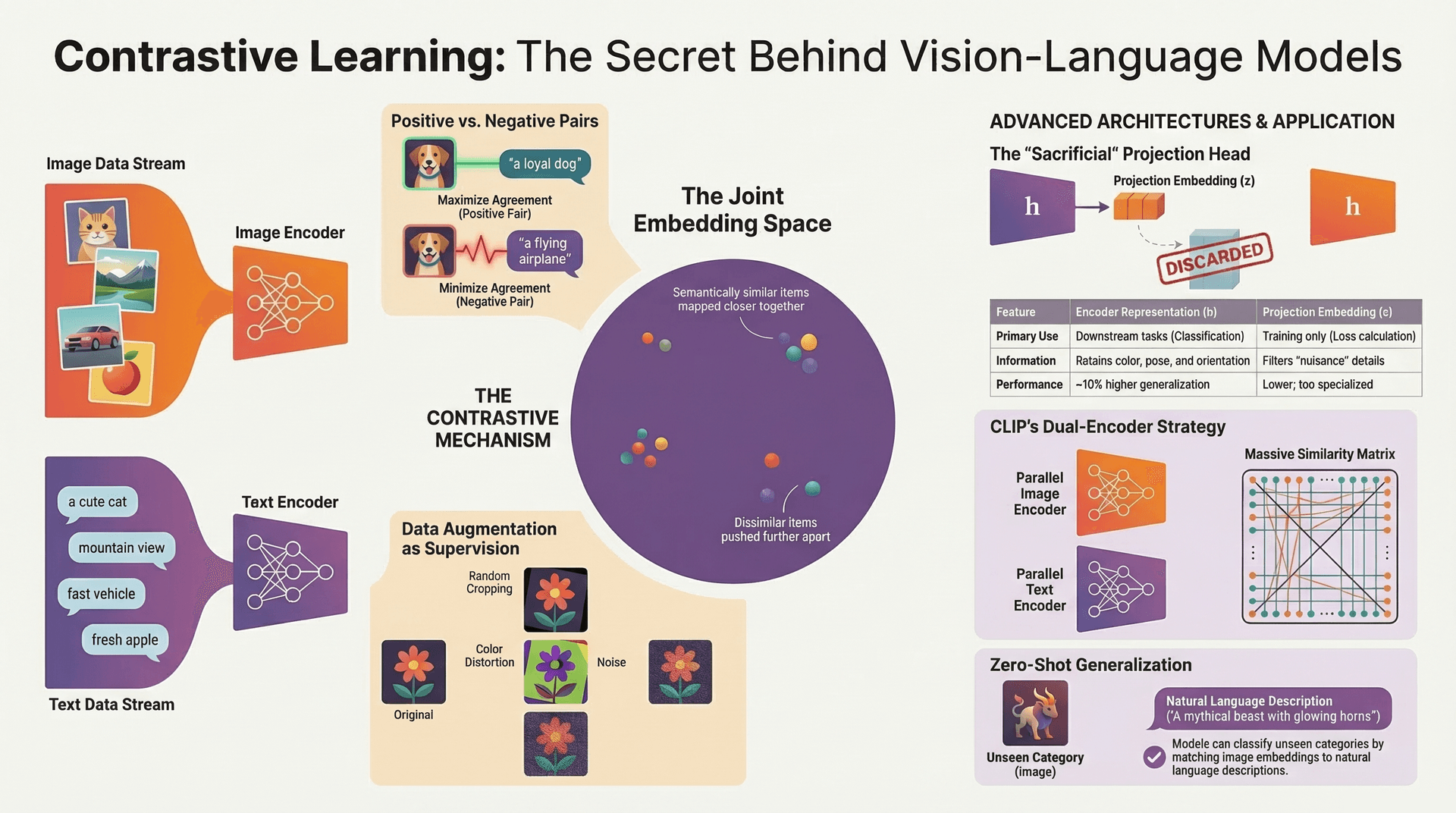
Artificial intelligence has become much better at understanding both images and text together, which is a big step forward in machine learning. This is made possible by Vision Language Models (VLMs), which help us work with and understand different types of data at the same time. One important technique behind this progress is called contrastive learning. It helps models learn meaningful patterns by figuring out what is similar and what is different between pieces of data.
Understanding the Joint Embedding Space
Before delving into contrastive learning, it's crucial to understand the concept of an embedding space. In machine learning, an embedding space is a mathematical space where complex, high-dimensional data like words, sentences, images, or audio are transformed into lower-dimensional numerical vectors. These vectors, also known as embeddings, capture the inherent meaning, properties, and relationships between the original data points.
Key Insight: Semantically similar items are placed closer together in the embedding space, while dissimilar items are pushed further apart. This geometric arrangement allows machine learning algorithms to process and compare diverse data types more effectively.
VLMs specifically aim to create a joint embedding space. In this shared space, representations of different modalities (e.g., an image of a dog and the text "a dog") that share semantic meaning are mapped to nearby points. Conversely, an image of a dog and the text "a cat" would be represented by vectors that are far apart.
The Core Principle of Contrastive Learning
Basically, contrastive learning is a self-supervised technique where a model learns by contrasting data points against each other. The fundamental objective is to:
Maximize Agreement between positive pairs - items that are semantically similar.
Minimize Agreement between negative pairs - items that are semantically dissimilar.
This process encourages the model to learn features that are invariant to permissible transformations and highly discriminative between different concepts.
+-------------------------+      +-----------------------------+      +-----------------------------+
| Original Image (Anchor) |      | Augmented Image (Positive)  |      | Different Image (Negative)  |
|      🐕 Dog Photo       |      |     🐕 Cropped Dog          |      |       🐈 Cat Photo          |
+------------+------------+      +--------------+--------------+      +--------------+--------------+
             |                                   |                                    |
             v                                   v                                    v
+--------------------------------------------------------------------------------------------+
|                                   Embedding Space                                          |
|                                                                                            |
|  🐕 [Dog Photo Vector]  ◄══════►  🐕 [Cropped Dog Vector]       ✅ High Similarity         |
|                                                                                            |
|  🐕 [Dog Photo Vector]  ◄─ ─ ─ ─ ─ ─ ─ ─ ─ ─ ─ ─►  🐈 [Cat Vector]   ❌ Low Similarity     |
+--------------------------------------------------------------------------------------------+
SimCLR: A Foundational Framework for Visual Representations
A pivotal development in contrastive learning came with SimCLR in . Developed by Google Brain researchers, SimCLR demonstrated that strong visual representations could be learned effectively without requiring labeled data, purely through self-supervision.
The SimCLR framework operates on four main components:
| # | Component | Role | Output |
|---|---|---|---|
| 1 | Data Augmentation Module | Generates two different augmented "views" from each input image | xi, xj (positive pair) |
| 2 | Base Encoder Network (f) | Neural network (often ResNet) that extracts high-dimensional representations | hi, hj |
| 3 | Projection Head (g) | Small MLP that maps high-dimensional representations to a lower-dimensional embedding space | zi, zj |
| 4 | Contrastive Loss Function | Measures similarity, pulls positive pairs closer, pushes negatives apart | Loss signal |
Why is the Projection Head Discarded?
A natural question arises: if the projection head is part of the trained pipeline, why throw it away? The answer lies in information preservation and the distinct roles each component plays.
During the full SimCLR training pipeline, there are two stages of mapping:
| Stage | Component | Mapping | Typical Dimensions |
|---|---|---|---|
| 1 | Base Encoder (f) | Raw image x → representation h | e.g., 2048-d (ResNet-50) |
| 2 | Projection Head (g) | Representation h → embedding z | e.g., 128-d |
Once training is complete and g is discarded, you simply stop at stage 1. The "embeddings" for downstream tasks become the vectors h produced by the encoder, which are typically higher-dimensional and more information-rich.
Reasons to Discard the Projection Head
-
Prevents Information Loss The projection head is trained so that it doesn’t get affected by changes like rotation or color variations in the data. While this helps the model recognize an object regardless of its orientation, it effectively discards that orientation/color data. If your downstream task requires knowing an object's direction or color, the projection output z would perform poorly because it has filtered that information out.
-
Higher Generalization Performance Empirical studies show that representations before the projection head (h) perform significantly better, often by over 10% on generalization tasks like image classification compared to the vectors after the head (z).
-
Mitigates Dimensional Collapse The projection head encourages "uniformity" in the embedding space to prevent all inputs from collapsing into a single point. By discarding it, you access the encoder's internal space, which is typically more expressive and contains more complex semantic features.
| Feature | Encoder Representation (h) | Projection Embedding (z) |
|---|---|---|
| Primary Use | Downstream tasks (classification, detection, etc.) | Contrastive training (loss calculation only) |
| Information | It keeps features that aren’t very important, like color, pose, or orientation. | It removes unimportant features like color, pose, or orientation to stay consistent. |
| Performance | Higher (better for transfer learning) | Lower (too specialized for training objective) |
| Dimensions | Typically larger (e.g., 2048) | Typically smaller (e.g., 128) |
If Discarding Helps - Why Use It During Training at All?
If we didn't use a projection head during training, the contrastive loss would be applied directly to the encoder's output (h). This would force the encoder to become perfectly invariant to augmentations - which sounds good but is actually a double-edged sword. The projection head is a necessary "middleman" for three critical reasons:
-
It Acts as a "Lossy Filter"
The contrastive loss (NT-Xent) is very aggressive - it wants to strip away any information that distinguishes two augmented versions of the same image.
- With the head: The projection head g does the "dirty work" of throwing away information (like color or exact rotation) to satisfy the loss.
- Result: The encoder f is shielded. It learns the core features of the object without being forced to delete "nuisance" details that might be useful for future tasks.
-
Dimensionality Compression
Contrastive loss works best in lower-dimensional spaces (e.g., 128 units). If you applied the loss directly to a 2048-unit ResNet output, the model might struggle to converge or suffer from "dimensional collapse" - where the model finds shortcuts to solve the contrastive task without learning deep semantic features. The projection head compresses the data into a space where calculating cosine similarity is more effective.
-
Non-Linearity is the Secret Sauce
The projection head is typically an MLP with a ReLU activation. This non-linearity is crucial - research showed that using a non-linear head improves the quality of representation h by over 10% compared to a linear head or no head at all. It allows the network to maintain a linear relationship with the data in the encoder while using a complex, non-linear transformation to satisfy the contrastive objective.
The "Sacrificial Lamb" Analogy: Think of the projection head as a sacrificial layer. It takes the "hit" of the specialized training objective so that the encoder can stay a generalist. Once training is over, you discard the specialist and keep the generalist.
A Note on SimCLR v2
It is worth noting that SimCLR v2 changed this approach slightly. Instead of discarding the entire projection head, researchers found that fine-tuning from a middle layer of a deeper projection head gives better performance than discarding it entirely, suggesting that some learned transformations in the head can still be beneficial when adapted to the downstream task.
graph TD
A[Original Image x] --> B1{Augmentation t};
A --> B2{Augmentation t'};
B1 --> C1[Augmented View xi];
B2 --> C2[Augmented View xj];
C1 --> D1[Base Encoder f];
C2 --> D2[Base Encoder f];
D1 --> E1[Representation hi];
D2 --> E2[Representation hj];
E1 --> F1[Projection Head g];
E2 --> F2[Projection Head g];
F1 --> G1[Embedding zi];
F2 --> G2[Embedding zj];
G1 & G2 --> H{Contrastive Loss};
H --> I[Model Parameters Update];
Creating Effective Positive and Negative Pairs
The success of contrastive learning heavily relies on the quality of positive and negative pairs.
1. Data Augmentation for Self-Supervised Learning
For self-supervised scenarios where explicit labels are absent, data augmentation is the key to generating positive pairs. By applying various transformations to an input, multiple correlated "views" are created - all considered positive pairs because they stem from the same underlying data point.
Common data augmentation techniques include:
| Category | Techniques |
|---|---|
| Geometric Transformations | Random cropping, resizing, horizontal flipping, rotation |
| Color Distortions | Color jitter (brightness, contrast, saturation, hue), grayscale conversion, solarization |
| Noise Injection | Gaussian noise, Gaussian blur |
Stronger and more diverse augmentations often lead to better learned representations. Without effective augmentation, a model might overfit to superficial features rather than learning robust, invariant characteristics.
     Original              Crop & Resize          Color Jitter
┌──────────────────┐  ┌──────────────────┐  ┌──────────────────┐
│                  │  │                  │  │                  │
│  [Image of Dog]  │  │ [Dog head only,  │  │ [Dog w/ altered  │
│                  │  │   resized]       │  │  brightness]     │
└──────────────────┘  └──────────────────┘  └──────────────────┘

    Gaussian Blur        Horizontal Flip       Grayscale
┌──────────────────┐  ┌──────────────────┐  ┌──────────────────┐
│                  │  │                  │  │                  │
│  [Dog w/ blur]   │  │ [Dog mirrored]   │  │ [Dog desaturated]│
│                  │  │                  │  │                  │
└──────────────────┘  └──────────────────┘  └──────────────────┘
2. Semantic Alignment for Vision Language Models
In VLMs like CLIP, positive pairs are explicitly defined by semantically aligned multimodal inputs:
| Pair Type | Image | Text | Relationship |
|---|---|---|---|
| Positive | Dog photo | "A photo of a dog" | Semantically aligned |
| Negative | Dog photo | "A photo of a cat" | Semantically mismatched |
The Contrastive Loss Function: InfoNCE
The mathematical backbone of contrastive learning is the loss function, typically a variant of InfoNCE loss. It maximizes the mutual information between positive pairs while pushing apart negative pairs.
Here's the step-by-step process:
-
Step 1 - Similarity Metric
The similarity between two embeddings (za, zp) is measured using cosine similarity. When embeddings are L2-normalized, this simplifies to a dot product:
sim(za, zp) = (za · zp) / (‖za‖ × ‖zp‖) -
Step 2 - Converting to Probability
Similarity scores are converted into a probability distribution using a Softmax function. This calculates the probability that anchor zi matches positive zj among all candidates:
P(correct_pair) = exp(sim(zi, zj) / τ) / Σ_all_pairs( exp(sim(zi, zk) / τ) ) -
Step 3 - Loss Calculation
The loss for a single positive pair is the negative logarithm of this probability:
L = −log( P(correct_pair) )Minimizing this loss means maximizing P(correct_pair). High probability → low loss. Uncertainty or misclassification → high loss (penalty).
-
Step 4 - Temperature (τ)
A crucial hyperparameter (typically 0.01–0.2) that scales similarity scores before Softmax:
Temperature Effect Behavior Low τ Sharper Softmax output Increases contrast, forces model to differentiate hard negatives High τ Smoother distribution More gradual, exploratory learning
graph TD
A[Anchor Embedding zi] --> B{Calculate Similarity};
P[Positive Embedding zj] --> B;
N[Negative Embeddings zk] --> B;
B --> C{Similarity Scores s};
C --> D{Divide by Temperature τ};
D --> E{Apply Softmax};
E --> F[Probability of Positive Pair P_pos];
F --> G{Take Negative Logarithm};
G --> H[InfoNCE Loss];
CLIP: A Pioneer in Vision Language Models
CLIP, introduced by OpenAI in , stands as a seminal VLM that powerfully leverages contrastive learning. CLIP's breakthrough was its ability to learn robust, transferable visual representations from natural language supervision, rather than relying on fixed, hand-labeled datasets.
CLIP Architecture and Training
CLIP employs a dual-encoder architecture:
| Encoder | Input | Architecture | Output |
|---|---|---|---|
| Image Encoder | Raw images | ResNet or ViT | Image embeddings (zi) |
| Text Encoder | Text captions | Transformer | Text embeddings (zt) |
These two encoders are trained jointly to project images and text into a shared, multimodal embedding space.
┌─────────────────────┐          ┌─────────────────────┐
│    🖼️ Image Input   │          │     Text Input      │
│   [Photo of a Dog]  │          │  "A photo of a dog" │
└──────────┬──────────┘          └──────────┬──────────┘
           │                                │
           ▼                                ▼
┌─────────────────────┐          ┌─────────────────────┐
│   Image Encoder     │          │    Text Encoder     │
│   (ResNet / ViT)    │          │   (Transformer)     │
└──────────┬──────────┘          └──────────┬──────────┘
           │                                │
           ▼                                ▼
┌─────────────────────┐          ┌─────────────────────┐
│ Image Embedding z_i │          │ Text Embedding z_t  │
└──────────┬──────────┘          └──────────┬──────────┘
           │                                │
           └──────────►  🔗  ◄──────────────┘
                    Shared Embedding
                        Space
                         │
                         ▼
┌─────────────────────────────────────────────────────────┐
│            Contrastive Loss (InfoNCE)                   │
│  Maximize similarity for matches                        │
│  Minimize similarity for non-matches                    │
└─────────────────────────────────────────────────────────┘
Similarity Matrix and Loss
During training, a batch of N (image, text) pairs (Ik, Tk) is fed into the model. CLIP computes an N × N similarity matrix:
| T1 | T2 | T3 | … | TN | |
|---|---|---|---|---|---|
| I1 | ✅ Positive | ❌ | ❌ | … | ❌ |
| I2 | ❌ | ✅ Positive | ❌ | … | ❌ |
| I3 | ❌ | ❌ | ✅ Positive | … | ❌ |
| … | … | … | … | ⋱ | … |
| IN | ❌ | ❌ | ❌ | … | ✅ Positive |
The diagonal elements (where i = j) are positive pairs; all off-diagonal elements are negative pairs.
The CLIP loss is a symmetric contrastive loss combining two objectives:
Image-to-Text Loss: For each image, computes Softmax probability of matching its correct text caption among all captions, then takes the negative logarithm.
Text-to-Image Loss: Symmetrically, for each text caption, computes Softmax probability of matching its correct image among all images, then takes the negative logarithm.
The final CLIP loss is the average of both components.
graph TD
A[Batch of N Image-Text Pairs] --> B{Image Encoder};
A --> C{Text Encoder};
B --> D[N Image Embeddings];
C --> E[N Text Embeddings];
D & E --> F{Compute N x N Similarity Matrix};
F --> G{Apply Symmetric Contrastive Loss Image-to-Text & Text-to-Image};
G --> H[Update Image & Text Encoder Weights];
Zero-Shot Prediction with CLIP
One of CLIP's most impressive capabilities is its zero-shot transfer performance. After pre-training on a massive dataset of image-text pairs, CLIP can classify images for categories it has never explicitly seen during training.
The zero-shot classification process:
| Step | Action | Example |
|---|---|---|
| 1 | Create text descriptions for new categories | "A photo of an airplane", "A photo of a car", "A photo of a dog" |
| 2 | Encode text descriptions → text embeddings | C1, C2, C3 |
| 3 | Encode input image → image embedding | I |
| 4 | Calculate cosine similarity between image and each text | sim(I, C1), sim(I, C2), sim(I, C3) |
| 5 | Predict the class with highest similarity | → "A photo of a dog" ✅ |
┌──────────────────┐          ┌──────────────────────────────┐
│ 🖼️ Input Image   │          │     Candidate Texts          │
│ [Unknown Object] │          │  • "A photo of a cat"        │
└────────┬─────────┘          │  • "A photo of a dog"        │
         │                    │  • "A photo of a bird"       │
         ▼                    └──────────────┬───────────────┘
┌──────────────────┐                         │
│  Image Encoder   │                         ▼
└────────┬─────────┘          ┌──────────────────────────────┐
         │                    │       Text Encoder           │
         ▼                    └──────────────┬───────────────┘
┌──────────────────┐                         │
│ Image Embedding  │                         ▼
│   (Vector I)     │          ┌──────────────────────────────┐
└────────┬─────────┘          │ Text Embeddings              │
         │                    │ (Vectors C1, C2, C3)         │
         │                    └──────────────┬───────────────┘
         │                                   │
         └───────────┬───────────────────────┘
                     ▼
  ┌──────────────────────────────────────────────────────┐
  │    Cosine Similarity                                 │
  │    sim(I, C1) = 0.12                                 │
  │    sim(I, C2) = 0.87  ◄── Highest!                   │
  │    sim(I, C3) = 0.25                                 │
  └──────────────────────────┬───────────────────────────┘
                             ▼
  ┌──────────────────────────────────────────────────────┐
  │    Prediction: "A photo of a dog"                    │
  └──────────────────────────────────────────────────────┘
Strengths and Limitations of Contrastive Learning in VLMs
| Strengths | Limitations |
|---|---|
| Zero-Shot Transfer - Models like CLIP generalize to unseen concepts without explicit fine-tuning, reducing the need for labeled data. | Hard Negatives Challenge - Some negative pairs may still be semantically close (e.g., "a dog" caption vs. a black dog image). Large datasets help mitigate this. |
| Robust Representations - Diverse augmentations and contrastive objectives produce semantically rich, invariant embeddings. | Computational Cost - Large batch sizes required for InfoNCE loss make training expensive due to all-pairs similarity computation. |
| Scalability - Frameworks benefit from larger batches and datasets, enabling training on vast unlabeled data. | Augmentation Strategy - Poorly chosen or overly aggressive augmentations can mislead the model or break semantic consistency. |
Real-World Applications of Vision Language Models
VLMs powered by contrastive learning are transforming various industries:
| Application | Description |
|---|---|
| Image Search & Retrieval | Search for images using natural language queries, or find similar products by uploading an image. |
| Content Moderation | Jointly analyzing images and text to detect and filter inappropriate or harmful content. |
| Visual Question Answering | Systems that answer questions about image content, enabling more intuitive human-AI interaction. |
| Image Captioning & Accessibility | Automatically generating descriptive captions to enhance accessibility for visually impaired users. |
| Robotics & Autonomous Systems | Robots understanding verbal commands with visual cues - e.g., "pick up the red cup next to the book." |
| Healthcare & Medical Imaging | Analyzing medical images (X-rays, etc.) and providing descriptive reports or highlighting abnormalities. |
| Autonomous Driving | Combining visual data from cameras with textual data from maps and traffic signs for better decision-making. |
| Document Understanding | Extracting structured data from scanned documents, forms, or handwritten notes. |
Conclusion
Contrastive learning has emerged as an indispensable technique for developing powerful Vision Language Models. By teaching models to learn semantically meaningful representations through the principle of maximizing agreement for positive pairs and minimizing it for negative pairs, it has unlocked groundbreaking capabilities.
From the foundational SimCLR framework to the influential CLIP model, contrastive learning enables VLMs to understand the intricate relationships between images and text - leading to robust zero-shot generalization and a wide array of transformative real-world applications.
As research continues to evolve, contrastive learning will undoubtedly remain a cornerstone in the pursuit of more intelligent and adaptable multimodal AI systems.
Further Reading
- Self-supervised Learning Architectures
- Mutual Information in Machine Learning
- Transformer Networks for Vision and Language
- Zero-shot and Few-shot Learning
- Multimodal Deep Learning Applications