Agent Harnesses Explained: State, Memory, and Reliability in AI Systems
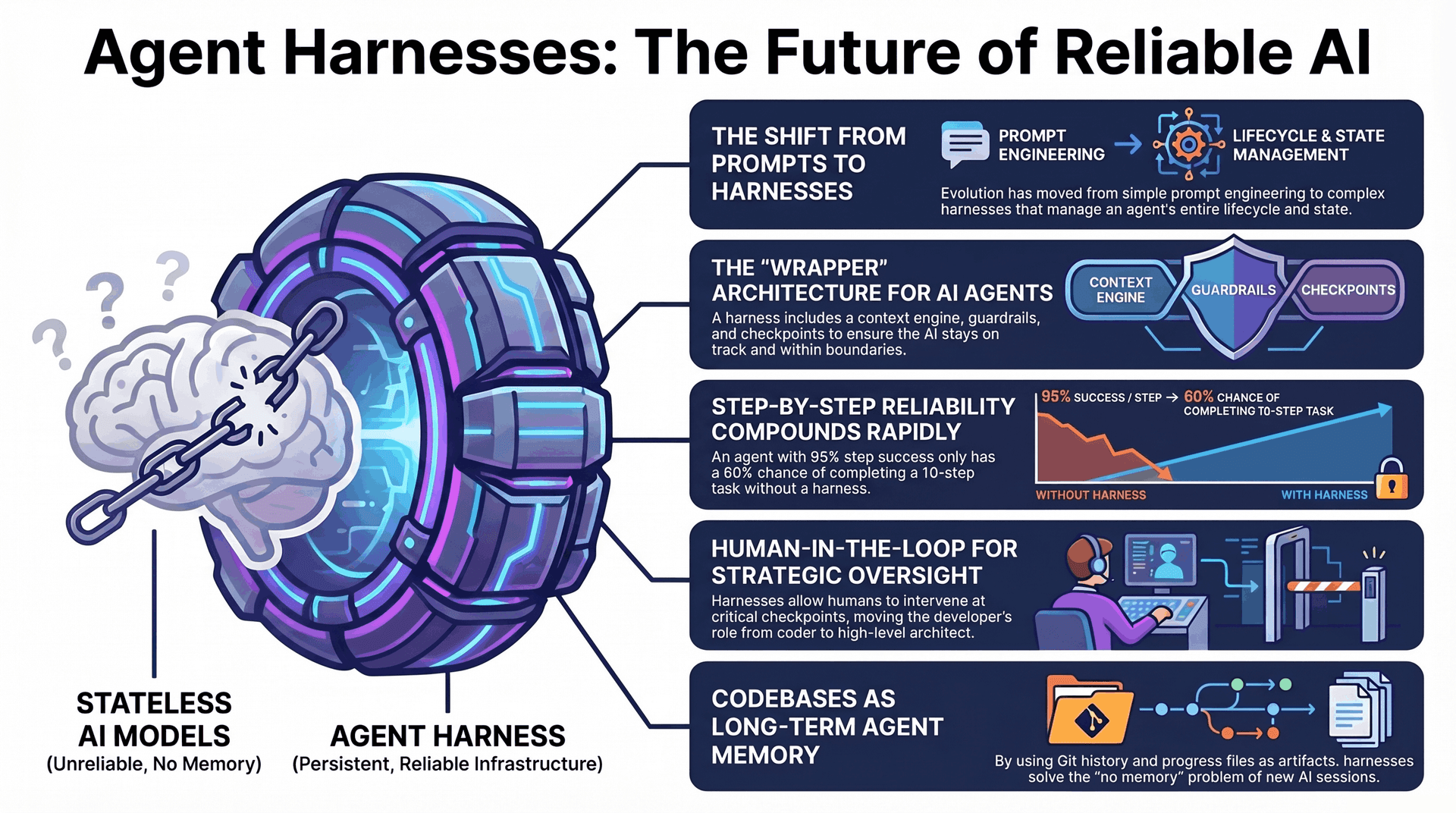
AI is advancing incredibly fast, especially with large language models (LLMs). These models aren't just changing how we use technology. They're fundamentally transforming software development itself. As developers shift their focus from simply building more powerful LLMs to creating smarter systems around them, a new pattern has emerged: Agent Harnesses. This breakthrough has the potential to make AI agents capable of handling long, complex tasks reliably and consistently.
This blog post will delve into the evolution of AI agent architectures, explain why agent harnesses are critical now, explore their core components, and examine the challenges that still need to be overcome to fully realize the vision of "vibe coding."
Understanding Key Terminology
Before diving deeper, let's clarify some fundamental terms:
- Large Language Model (LLM): A type of artificial intelligence program that can recognize and generate text, translate languages, write different kinds of creative content, and answer your questions in an informative way.
- AI Agents (or Agentic AI): Autonomous AI systems that can act independently to achieve pre-determined goals, often performing complex, multi-step problems with limited human supervision. They can perceive, reason, and act on their own, often integrating with other software systems to complete tasks.
- Prompt Engineering: The process of designing and refining input instructions, known as prompts, to effectively guide an LLM to generate desired outputs. It focuses on crafting specific queries to optimize single interactions.
- Context Window: This refers to the hard cap on how much text an LLM can process and respond to at once. It includes all input (prompts, retrieved documents, conversation history) and generated output, acting as the model's short-term memory. If information falls outside this window, the LLM may lose track or misunderstand.
- Context Rot: The degradation of an LLM's performance as the input length increases, even on simple tasks, due to the model struggling to maintain focus or adequately process all information within the context window.
- Artifacts: In the context of agent harnesses, these are persistent outputs or saved states (e.g., code files, test results, progress logs) generated by an agent during its operation, which can be used for state persistence and handoffs.
- Guardrails: Pre- and post-execution checks and policies applied to AI agents to ensure their actions remain within defined boundaries, ensuring safety, compliance, and desired behavior.
- Handoffs/Offloading: Mechanisms that allow agents to save and transfer relevant context and progress to another agent or a subsequent session, crucial for overcoming the "no memory" problem of new LLM interactions.
- Checkpoints: Intermediate points in an agent's workflow where its state, progress, or output is saved and optionally validated. This allows for recovery from failures and ensures continuity across long-running tasks.
- Human-in-the-Loop (HITL): The intentional integration of human oversight into autonomous AI workflows at critical decision points. Humans can review, approve, or provide feedback to agents, ensuring accuracy, safety, and ethical decision-making.
- Vibe Coding: A method of software development where AI tools heavily assist in generating, refining, and debugging code based on natural language prompts, allowing developers to focus on high-level design and problem-solving rather than writing every line of code manually.
The Evolution of AI Agent Architecture
The journey towards sophisticated AI agents capable of handling complex, long-running tasks has been marked by several significant architectural shifts:
1. Prompt Engineering (2020-present)
Initially, the interaction with LLMs was largely dominated by prompt engineering. This phase focused on crafting optimal, often static, one-shot instructions to elicit a desired response from the LLM. It was about perfecting the art of the query for single interactions, with little to no memory or state persistence between turns.
2. Context Engineering (Early 2023-present)
As LLMs became more capable, the limitations of static prompting became apparent. This led to the emergence of context engineering. This discipline goes beyond a single prompt, focusing on dynamically building and managing the entire information environment an LLM sees. It orchestrates everything that fills the context window, providing the model with exactly what it needs at the right time.
Key strategies in context engineering include:
- Reduction/Compaction: Summarizing or condensing previous interactions to fit within token limits.
- Offloading: Moving less critical information to external memory systems.
- Isolation: Segmenting context to prevent interference between different parts of a task.
- Retrieval-Augmented Generation (RAG): Dynamically fetching relevant information from external knowledge bases.
This phase recognized the LLM as the "CPU" and the context window as its "RAM," emphasizing the need for efficient memory management.
3. Agent Harnesses (2025+)
The latest evolution introduces Agent Harnesses. These are not merely context management systems but comprehensive infrastructures built around AI agents to enable them to tackle long-running, multi-session tasks reliably. Agent harnesses incorporate context engineering, enhancing it with capabilities for state persistence, validation, checkpoints, and human oversight.
The transition marks a shift from optimizing single LLM calls to engineering robust, persistent systems that manage the entire lifecycle of complex agentic workflows.
Why Agent Harnesses Are Crucial Now
The urgency for agent harnesses stems from several critical observations in the AI development landscape:
- Maturing LLM Capabilities: While LLM capabilities continue to improve, the "raw power" explosion seen in 2022-2024 is leveling off. The focus has shifted from building inherently more powerful models to constructing sophisticated systems around existing LLMs.
- System-Level Innovation: The real advancements now lie in building robust, reliable systems that leverage LLMs for complex, multi-step tasks. This includes improvements in reasoning, memory systems, prompting techniques, and tool optimization.
- Untapped Potential: This shift presents a significant opportunity for developers to innovate on top of LLMs, moving beyond simple conversational agents to truly autonomous and semi-autonomous systems.
Core Concepts of Agent Harness Architecture
An agent harness acts as a sophisticated wrapper, providing essential services that enable agents to perform beyond individual, stateless interactions.
Layers Wrapping Layers
The architecture of an agent harness can be visualized as layers wrapping each other, creating a robust operational environment:
graph TD
A[Harness Layer] --> B[Context Engine]
B --> C[Agents]

A -- "Provides Overall Control & Persistence" --> A_features(State Persistence Validation Checkpoints Handoffs Human Loop Guardrails)
B -- "Manages Agent Interactions & Memory" --> B_features(Context Compaction Retrieval Isolation Offloading)
C -- "Executes Specific Tasks" --> C_features(LLMs Tools Task Logic)

style A fill:#FFC,stroke:#333,stroke-width:2px
style B fill:#CFF,stroke:#333,stroke-width:2px
style C fill:#FCF,stroke:#333,stroke-width:2px
Key Architectural Principles:
- Connecting Sessions: Harnesses enable connecting multiple agent sessions, whether these are different specialized agents or a single agent performing iterative tasks. This is crucial for handling longer, more complex workflows that span extended periods.
- Context Management: Within each session, context engineering strategies (compaction, retrieval, isolation, offloading) remain vital. These techniques prevent "context rot" and manage token limits, ensuring the agent has access to the most relevant information without being overwhelmed.
-
Persistence & Control:
- State Persistence: Managed through mechanisms like progress files, Git state, and generated artifacts. The codebase itself, combined with Git history and artifacts, effectively becomes the long-term memory for the agents.
- Validation: Incorporates both agent self-validation (e.g., running tests) and human validation (human-in-the-loop) to ensure correctness and adherence to requirements.
- Coordination: Checkpoints and handoffs allow for structured communication and task transfer between agents or even human operators.
- Guardrails: Essential pre- and post-execution checks that ensure agents operate within defined constraints, maintaining safety and preventing unintended actions.
Anatomy of an Agent Harness: Key Components
An agent harness is a sophisticated system comprising several interconnected components, each playing a vital role in enabling reliable, long-running AI agent operations.
- Context Engine: The brain of the harness for information management. It oversees the agents (e.g., an Initializer, a Task Agent), managing their progress files, Git state, and generated artifacts. Its primary function is to curate and deliver the optimal context to the LLM at each step.
- Guardrails: These are a set of rules and checks applied before and after an agent executes an action. They ensure that tasks remain "on the rails," preventing agents from deviating from their intended purpose or compromising the codebase's integrity.
-
Checkpoints: Strategic points within the workflow where
an agent's progress and state are saved. Checkpoints serve multiple
purposes:
- Failure Prevention: Allows rolling back to a stable state if a subsequent step fails.
- Progress Tracking: Provides a clear audit trail and enables monitoring of long-running tasks.
- Handoff Points: Facilitates seamless transfer of work between different agents or human operators.
- Handoffs/Offloading: A critical mechanism to address the "no memory" problem of new LLM sessions. Agents package and save relevant context and progress (as artifacts) to be loaded by the next agent or session. This ensures continuity and prevents repetitive work.
-
Human Loop (Human-in-the-Loop - HITL): This component
enables human intervention at crucial stages of the agent's workflow.
- Validation: Humans can validate agent actions or outputs.
- Guidance: Provide directional input or correct misconceptions.
- Takeover: Assume control when a task is too complex, risky, or requires nuanced human judgment.
- Learning: Human feedback helps improve the agent's performance over time.
- Validation: A continuous process integrated throughout the harness. It ensures the correctness of agent outputs, the health of the environment, and adherence to task requirements. Often works in conjunction with checkpoints and the human loop.
- Memory Persistence: Beyond the immediate context window, the harness ensures long-term memory. This is typically achieved by treating the codebase, Git history, and generated artifacts as the collective memory and state for the agents.
graph TD
    subgraph "Agent Harness Layer"
        A[Context Engine] --> B[Agents]
        A -- Manages --> C[Progress Files]
        A -- Manages --> D[Git State]
        A -- Manages --> E[Artifacts]
        B -- Runs --> F[Tools/LLMs]

        H[Guardrails] -- Pre/Post Execution Checks --> B
        I[Checkpoints] -- State Saving & Recovery --> B
        J[Handoffs/Offloading] -- Context Transfer --> B
        K[Human Loop] -- Oversight & Intervention --> B
        L[Validation] -- Ensures Correctness --> B

        style A fill:#F9F,stroke:#333,stroke-width:2px
        style B fill:#CCF,stroke:#333,stroke-width:2px
        style C fill:#CCC,stroke:#333,stroke-width:1px
        style D fill:#CCC,stroke:#333,stroke-width:1px
        style E fill:#CCC,stroke:#333,stroke-width:1px
        style F fill:#FFF,stroke:#333,stroke-width:1px
        style H fill:#FF9,stroke:#333,stroke-width:2px
        style I fill:#9FF,stroke:#333,stroke-width:2px
        style J fill:#F6F,stroke:#333,stroke-width:2px
        style K fill:#CFC,stroke:#333,stroke-width:2px
        style L fill:#9CF,stroke:#333,stroke-width:2px
    end
Illustrative Example: An Agent-Driven Coding Session
Consider a multi-session coding task where an AI agent needs to develop a new software feature. An agent harness facilitates this process by providing structure and memory.
- Priming a New Session: When a new agent session begins (or resumes), the harness first instructs the agent to read existing progress files and the Git log. This crucial step overcomes the LLM's inherent "no memory" problem, allowing the agent to quickly understand the current state of the project, previous work, and any open tasks.
- Environment Verification: Next, the agent runs tests and verifies the environment health. This acts as an initial checkpoint and guardrail, ensuring a stable foundation before proceeding.
- Task Selection: The agent then intelligently selects the highest-priority feature to work on, drawing from a predefined list or an evolving task board.
- Implementation and Validation: The agent implements the chosen feature and immediately self-validates its work, typically by running relevant tests. This stage might also involve a human loop for complex decisions or code reviews.
-
Session Handoff: Upon completion or at designated
intervals, the agent
updates its
progress.txtfile and commits changes to Git. These serve as clean handoff artifacts, providing a durable record of work and preparing the environment for the next session or agent.
This systematic approach, managed by the harness, transforms an LLM from a stateless text generator into a productive, persistent contributor to a development project.
Industry Application: Outsystems Agent Workbench
Platforms like the Outsystems Agent Workbench exemplify how agent harness principles are being implemented for enterprise-ready AI agent solutions. These platforms provide a low-code environment for building, deploying, and governing AI agents, offering critical features for production environments:
- Observability: Built-in monitoring and analytics dashboards track agent performance, error rates, health scores, and model usage, providing transparency into AI operations.
- Guardrails: Predefined checks and balances ensure agents adhere to business rules and security policies.
- Human-in-the-Loop Support: Explicit mechanisms for human intervention and validation at critical junctures.
- Deployment & Management: One-click deployments across various environments, robust audit trails, logging, tracing, and user/environment management.
- Workflow-Driven: Utilizes extensible workflows to manage agent components like short-term memory, system prompts, long-term memory, and multi-agent interactions.
- Tooling Integration: Allows dynamic definition and integration of custom tools, enabling LLMs to interact with external systems and APIs.
Such platforms move AI agents beyond experimental prototypes, making them viable for complex enterprise workflows.
The Two Major Hurdles: Bounded Attention and Reliability
While agent harnesses represent a significant leap forward, two fundamental problems still prevent widespread "vibe coding" with full autonomy: bounded attention and reliability.
1. Bounded Attention (Context Rot)
- Problem: Even with increasingly large context windows (some models boast 200k+ tokens), LLMs still suffer from the "lost in the middle" phenomenon, where critical information embedded within long texts is overlooked. The sheer volume of tokens can overwhelm the model, leading to context rot, where performance degrades as input length increases. More tokens do not automatically equate to better focus or reasoning.
- Partial Solutions: Memory compaction, progress files, sub-agent isolation, and memory handoffs attempt to alleviate this.
- Still Missing: Optimal summarization that consistently captures critical information, predictive context (knowing what information future sessions will need), and true cross-session continuity where agents don't repeat mistakes due to incomplete handoff summaries.
2. Reliability
- Problem: The step-by-step reliability of current AI agents is often less than 100%. Even a seemingly high 95% step success rate compounds over multiple steps, leading to drastically lower overall reliability for complex tasks. For instance, an agent with 95% step reliability performing a 10-step task has only about a 60% chance of completing it successfully (0.95^10 ≈ 0.599). This drops to roughly 36% for a 20-step task (0.95^20 ≈ 0.358).
- Production Need: Real-world production systems demand much higher reliability, often 99.9% or more, which is far beyond current multi-step agent performance.
- Partial Solutions: Checkpoint workflows (allowing pause and resume), automatic rollback using version control (like Git), and structured artifacts help manage failures.
- Still Missing: Easy and intuitive human injection points, smart placement of checkpoints to maximize impact, and finding the "right autonomy balance" where humans intervene strategically rather than constantly micro-managing.
The Future: "Vibe Coding" Reimagined
The concept of "vibe coding," where developers delegate significant portions of coding to AI, is indeed viable. However, it will not manifest as a purely autonomous AI working in isolation. Instead, the future of coding, facilitated by agent harnesses, will involve heavily engineered systems with continuous, intelligent human oversight.
If the problems of bounded attention and reliability can be effectively addressed, agent harnesses will unlock the "next phase" of AI capabilities. This future entails delegating 99% or more of coding tasks to AI agents, applicable across any type of long-running AI agent workflow.
The role of the human developer will transform from writing every line of code to becoming a high-level architect, strategist, and validator. By 2026, it is anticipated that humans will not write the majority of the code. Instead, we will guide, oversee, and refine the outputs of powerful, harness-equipped AI agents. This marks a profound shift, making "vibe coding" a reality, but one that is meticulously structured and collaboratively managed.
Conclusion
Agent harnesses represent a pivotal advancement in AI. By providing the essential infrastructure for state persistence, context management, validation, and human oversight, they are transforming LLMs from isolated tools into reliable, long-running agents capable of tackling complex tasks. While challenges such as bounded attention and multi-step reliability remain, ongoing innovation in agent harness architecture promises to usher in an era where AI agents become integral, trusted partners in software development and beyond. The future of coding is not about humans being replaced, but about humans and AI collaborating in a more powerful and efficient synergy, redefining what's possible in the digital realm.
Further Reading
- Advanced Prompt Engineering Techniques
- Memory Management Strategies for LLMs
- Architectures for Human-in-the-Loop AI Systems
- Designing Robust Multi-Agent Systems
- The Role of Observability in AI Deployments